Best Jazz Standards Sheet Music for Beginners to Pros
Answering your search for reliable jazz standards sheet music, this guide highlights five staple collections ideal for players at different levels. The selections range from comprehensive songbooks for piano, voice, and guitar to easy piano editions for new learners. Best for: intermediate to advanced players seeking broad repertoires, teachers assembling lesson plans, and beginners building fundamentals with accessible notation. The table below compares core details to help you choose quickly.
| Product | Best For | Format | Pages | Instrumentation |
|---|---|---|---|---|
| The Great American Songbook – Piano Vocal and Guitar Sheet Music Collection | Intermediate to Advanced | P/V/G | 418 | Piano/Vocal/Guitar |
| The Best Jazz Piano Solos Ever | Advanced Pianists | Piano Solo | 320 | Piano |
| Jazz Standards – Piano/Vocal/Guitar Songbook | Students & Adult Learners | P/V/C | 40 | Piano/Vocal/Guitar |
| Cocktail Piano Jazz Piano Solos Series Vol. 31 | Casual Performance | Piano Solo | 98 | Piano/Keyboard |
| The Ultimate Jazz Fake Book | All Skill Levels | Fake Book | Varies (635+ songs) | Piano/Vocal/Guitar |
The Great American Songbook – Piano Vocal and Guitar Sheet Music Collection

The Great American Songbook collects 100 jazz and Broadway standards in a piano/vocal/guitar format. This large volume is best for intermediate to advanced players who want a broad, anthology-style resource for performance and study. The included arrangements support a collaborative approach for singers, pianists, and guitarists working together on classic repertoire.
Who it’s best for: advanced students, teachers compiling a multi-voice repertoire, and performers seeking a substantial, varied source of standards. Why selected: its depth and range cover many essential standards in one comprehensive pull-out. Caution: the size and scope may be overwhelming for absolute beginners.
The Best Jazz Piano Solos Ever

This collection features 80 iconic jazz standards arranged for piano solo. It’s ideal for intermediate to advanced pianists who want authentic solo performance material with substantial challenge and musical variety. The book is a practical choice for practice routines, recitals, and classroom settings where students work toward polished, self-contained performances.
Best for: dedicated piano students and teachers focusing on solo performance. Better for: players who want a solid core of well-known tunes without accompaniment. Caution: some pieces assume a comfortable reading level and jazz vocabulary.
Jazz Standards – Piano/Vocal/Guitar Songbook
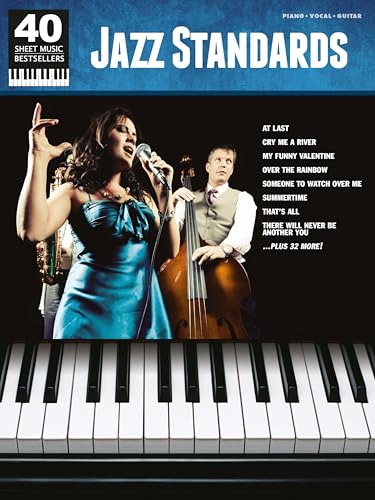
This is a compact, student-friendly collection featuring 40 classic jazz standards in piano/vocal/guitar format. It’s designed for classroom use and individual study, making it a practical core library for adult learners and teachers who want a curated set of staples. The arrangements are accessible yet musically substantial for classroom rehearsal and performance prep.
Best for: students and adult learners beginning their jazz journey with a reliable core repertoire. Why chosen: concise, well-chosen selections provide a balanced starting point. Limitation: fewer titles than larger anthologies, which may require supplementing with additional standards for complete coverage.
Cocktail Piano Jazz Piano Solos Series Vol. 31

This solo piano collection focuses on smooth, timeless standards suitable for lounge, cocktail hour, and intimate performances. With 23 solos, it’s a compact, approach-friendly option for casual performing and practice. The pieces emphasize melodic lines and accessible voicings appropriate for evening settings.
Best for: casual performers and students seeking stylish, approachable repertoire. Choose this if: you want refined, easy-to-learn pieces for intimate gigs. Caution: limited number of tunes may require pairing with a larger volume for broader coverage.
Jazz Standards – Super Easy Songbook

This beginner-friendly piano songbook presents 128 pages of easy jazz tunes with note names. It’s tailored for adults and students starting out with jazz standards, offering a gentle entry point into harmonic concepts and melodic phrasing without overwhelming notation.
Best for: absolute beginners and adults returning to music, seeking confidence-building pieces. Limitation: simplified arrangements may omit some authentic jazz nuances found in more advanced collections.
Jazz Standards for Accordion

This accordion-focused songbook compiles 17 classic jazz standards adapted for solo accordion performance, expanding the instrument’s standard repertoire. It’s a practical option for accordion players seeking familiar jazz landmarks with instrument-appropriate arrangements.
Best for: accordionists building jazz repertoire. Better for: players who want to explore standards beyond traditional piano-centric arrangements. Caution: smaller repertoire compared to full piano-centric songbooks.
The Ultimate Jazz Fake Book

The Ultimate Jazz Fake Book provides over 635 jazz songs spanning swing, bebop, Latin, and more, with chords and lyrics for piano, vocalists, and guitarists. It’s a versatile backbone for gigging musicians and educators who need quick repertoire options across genres and decades.
Best for: players who want a wide-ranging, chord-focused resource for jam sessions and teaching. Choose this if: you need quick access to chord symbols and lyric prompts. Caution: the sheer volume can be unwieldy for some learners; consider using a more focused collection for beginners.
Buying Guide
- What level are you playing at now? Choose a collection that matches your current ability and targets progression toward more complex arrangements.
- Do you want a piano-centric or multi-instrument approach? P/V/G songbooks help ensembles; solo piano books support individual practice.
- How broad should your repertoire be? If you’re building a recital or classroom library, larger anthologies offer more variety; if you practice for casual gigs, smaller, focused volumes can be more practical.
- Are note names, simplified notation, or standard notation important? Easy/Beginner books help with learning curves; standard notation suits advanced players and formal training.
- Is portability a factor? Compact volumes are easier for practice on the go; larger anthologies are best for home use or teaching studios.
Frequently Asked Questions
- What makes a jazz standards sheet music collection valuable? A strong collection offers a balanced mix of accessible pieces and authentic arrangements that support growth, performance readiness, and repertoire variety.
- Should beginners start with easy piano or larger songbooks? Beginners often benefit from easy piano or 40–60 piece collections to build confidence before tackling larger, more complex volumes.
- Are fake books useful for learning jazz standards? Yes, fake books provide flexible chord symbols and lead sheets, which are helpful for improvisation practice and ensemble rehearsal.
- Can I use these books for teaching? Many titles are classroom-friendly, offering a curated set of standards ideal for lessons, ensembles, and recitals.
- How should I choose between piano/voice/guitar formats and solo piano formats? P/V/G formats suit collaborative performing and accompaniment roles, while solo piano formats focus on melody, harmony, and finger dexterity alone.
- Do these books cover modern jazz standards or only classic tunes? The featured selections primarily center on classic standards, with some modern-era tunes represented in a few volumes.