Best Child Development and Education Books for Early Learners
Choosing effective educational books for young children can support crucial early learning milestones. This selection focuses on activities that promote handwriting readiness, logic and problem-solving, language development, and hands-on exploration. The following books and activity sets are designed to engage kids ages 0-8 with screen-free learning, durable materials, and age-appropriate challenges that align with foundational skills for school and daily life.
| Product | Age Range | Focus | Format |
|---|---|---|---|
| Preschool Learning Activities – Tracing Books for Kids Ages 3-5 | 3-5 | Letter tracing, shapes, numbers | Dry-erase workbook with markers |
| School Zone Thinking Skills Workbook | 3-5 | Problem-solving, logic, reasoning | Classic workbook |
| The Whole-Brain Child | All ages (guide for parents) | Brain development strategies | Book |
| Imitation Book: Learn to Talk | 0-4 | Speech development, language | Board book |
| Busy Book for Toddlers 3-5 | 3-5 | Tracing, reading, coloring, travel activities | Interactive busy book |
Best Tracing and Early Writing Activities For Preschoolers
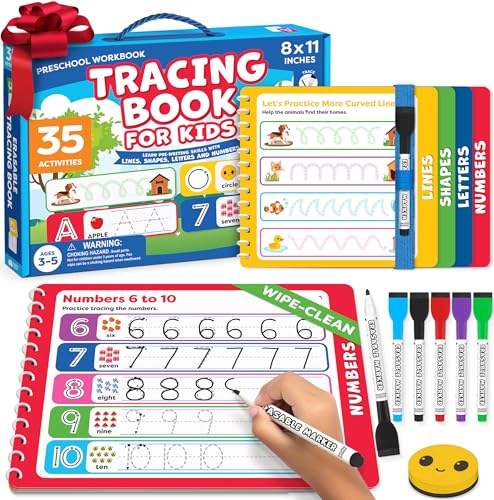
The Preschool Learning Activities book by Momo & Nashi combines tracing practice with colorful prompts to build confidence in young learners. This all-in-one dry-erase workbook includes six markers, a smiley eraser, a pen holder, and a sturdy storage box, making it easy for kids to reuse and stay organized. The activities are designed to promote independent play, device-free creativity, and essential handwriting skills for ages 3 to 5. Reusable materials support continuous practice and gradual mastery of letter strokes and shapes.
Key features emphasize fine motor development, pencil grip, and school readiness. The booklet encourages repetition to build recognition and memory for letter forms, numbers 1–10, and simple shapes. It is suited for homeschooling, daycare, or Montessori settings and aims to be ADHD-friendly by providing structured, engaging tasks that reduce screen time while fostering focus and persistence.
Thinking Skills Workbook For Preschoolers And Kindergartners

The School Zone Thinking Skills Workbook focuses on early reasoning and problem-solving for ages 3 to 5. It provides activities that encourage critical thinking, pattern recognition, counting, and basic logic. The workbook format supports progressive challenges, helping children translate classroom concepts into concrete thinking skills. Parents and teachers can use it to assess progress and adapt activities to individual learning paces while maintaining a fun, engaging approach to education.
The Whole-Brain Child: 12 Revolutionary Strategies

The Whole-Brain Child offers evidence-based strategies to nurture a child’s developing mind. While written for a broad audience, the book provides actionable guidance on how parents can help kids regulate emotions, strengthen resilience, and cultivate social-emotional skills. It presents 12 key approaches that integrate different parts of the brain to support healthy development. Although not a traditional workbook, this title complements hands-on activities by improving parent-child interactions and day-to-day learning experiences.
Imitation Book: Learn To Talk For Toddlers

This interactive board book is designed by a speech therapist to support early language development. It focuses on practical opportunities for toddlers to imitate sounds, words, and simple phrases. The content is organized for short sessions that fit into daily routines, with clear visuals and guided repetition. It can be a useful resource for caregivers working with late talkers or toddlers who need targeted language practice alongside natural play and reading times.
Busy Book For Toddlers: 3-5 Years

The Busy Book for Toddlers combines tracing, reading, and coloring with travel-friendly activities. It features 36 themes designed to develop recognition, writing, and fine motor skills, while supporting early literacy through engaging prompts. The book is marketed as suitable for 3- to 5-year-olds and can be used in classroom centers or at home. It also emphasizes sensory-friendly layouts to accommodate a range of learning styles, including children who benefit from multi-sensory approaches.
Buying Guide: Key Purchase Considerations And Comparisons
When selecting child development books and activity sets, consider the child’s age, interests, and developmental goals. For handwriting readiness, look for dry-erase formats that allow repeated practice and quick feedback. For language growth, prioritize books offering guided prompts, repetition, and opportunities for meaningful conversation. For logical thinking and problem-solving, choose activities with progressively challenging tasks and clear instructions that suit independent work or guided sessions.
Durability and versatility matter. Reusable materials and sturdy construction extend the life of the product, making it suitable for siblings or classroom use. Consider whether the content aligns with preschool or kindergarten curricula to ensure consistency with learning objectives. Some products support special needs or ADHD-friendly learning with structured tasks, while others emphasize sensory-rich experiences ideal for travel or quiet time.
Assessment and progress tracking can be helpful. Look for books that provide simple ways to monitor improvement, such as printable checklists or built-in rubrics. Additionally, evaluate the balance between screen-free activities and opportunities for guided exploration with parents or teachers. The best selections combine hands-on practice with purposeful teaching moments to foster lasting literacy, numeracy, and cognitive skills.
Finally, consider the format that best fits your routine. Dry-erase workbooks enable repeated practice in short sessions, while traditional paper books can support longer reading times and discussion. Busy books and interactive boards can be ideal for travel and classroom centers alike. With the right blend, these resources support a well-rounded early education that adapts to each child’s pace and interests.